Or: How Babelfish will not necessarily solve all your translation problems
(It’s a menu. But what a menu. Some of the dishes in it sound more like attack moves from Sailor Moon.)

Or: How Babelfish will not necessarily solve all your translation problems
(It’s a menu. But what a menu. Some of the dishes in it sound more like attack moves from Sailor Moon.)
And before I even made it out of bed.
In the inbox (because my Google address finally, inevitably I suppose, made it onto somebody’s mailing list):
“Compliments and Greetings. Please kindly allow me introduce myself. My names are Alan Backford, I am an accountant, by age 31 Years, graduate of the American Open University in Dubai, I am an English and I have returned to England for one reason; for the up bringing of my children in an English orientation. I was the head of the account department of a Private Bank in Netherlands and I would like to intimate you with certain facts that I believe would be of interest to you….”
Yeah, I just bet you would. Alan dear…let me intimate you with certain facts. (a) If you are “an English”, your school must be waaaaaaaay down the league tables. (b) The Powers that Be and I will be working fairly closely together in the coming weeks. So if you abruptly come down with a plague of boils, don’t be surprised. It’ll stop the minute you stop spamming.
(An “English orientation”? Is being English a lifestyle all of a sudden? I feel a Python sketch coming on. “Yeah, I went to this party…and somebody asked me if I, you know, wanted to try some tea…and then one of them took me out back and…and said, ”Ere, mate, come on, let’s play some cricket…'”)
Then, in the referral logs from EuropeanCuisines.com, this query to Google that brought someone to our site:
“What country does Swiss cheese come from”
Oh my gosh. And who’s buried in Grant’s Tomb? (But later Peter pointed out to me that the most likely answer to this question is “America” — as, in Switzerland, the cheese with the big holes is Emmentaler. The Swiss themselves [oh, all right, the Raetii then, be that way] haven’t had a caseus Helveticus since Julius Caesar’s time. [And that was probably Sbrinz anyway.])
Well, I hope we were of some assistance with the question.
…And there was something else as well, but it’s slipped my mind at the moment, as it was jarred out of place by something cutting Siff’hah suddenly said to Arhu, and I had to stop and write that down.
It’s good to start the day laughing…
In any given year, between about the 5th and the 17th or March, the stats at EuropeanCuisines.com go through the roof. I try to pay attention to the site, then, and put the links up here and there for people who’re interested. But what with one thing and another, I’m going to have zero time to deal with this next week: so for the bloggers among you who’re looking for Irish food tips in advance of The Day, here are the links for you…
The EuropeanCuisines.com website’s single most popular recipe, with more than 500,000 “hits” over the last five years: Peter’s Mum’s Soda Bread Recipe(s)
To supplement the above article, we’re offering a two-part video tutorial. Here it is in .wmv (Windows Moviemaker / Windows Media Player) format:
Also, because so many people ask for it: The Original Irish coffee recipe, developed at the old flying-boat base at Foynes (near the present Shannon Airport). The most important words in it: no whipped cream! (You’re supposed to use the heaviest pouring cream you can find.) The second most important words: no stirring!
(Links to our Irish recipe collections and the Irish cookbook guide can be found on the main Irish page at EuropeanCuisines.com.)
And a final, favorite side note: Why our site doesn’t have any recipes for corned beef and cabbage. And won’t.
(sigh) Now I can get back to cat-wizard things.
…and today, it’s not with The Big Meow, but with something else entirely… so don’t expect to hear much from me today (except distant shrieks of “What do you mean we didn’t bring the horseradish??”).
This point may take a little time to get to, so bear with me.
Peter and I are getting ready to do an afternoon cooking demonstration at the local hardware store, thus doing something to deserve our local reputation — most easily summed up as “You know, those two crazy people who live just outside of [name of small village omitted], the Americans — ” (at which I roll my eyes, because no American would mistake Peter’s accent as anything USAnian, though everyone here does) — “the ones who’re talking about food all the time, did you hear about the dinner they made for Pat and Mary Courtney… oh, they’re writers? Sure I didn’t know that. What do they write? Anyway, they made this terrific rolled pork loin and this rosemary-smoked lamb…”
— anyway, that reputation. So as part of the prep for this event (which will be happening at Quinns of Baltinglass on Saturday, February 25th, between 1:30 and 4:30, don’t miss it if you’re in the area), I went off to look for some pictures of Baltinglass Abbey to use as part of the promotional handout that Kieran the manager asked us to whip up. (The theme of the afternoon is “Bought in Baltinglass”, and the gist of the demonstration is to show that you can do incredible gourmet things with what’s available in a medium-sized Irish country town these days.)
And while looking around for photos in Google (to see if there was anything better than the pictures I might be taking myself this afternoon), I found — at the bottom of a page of pictures of someone’s megalith-ruin-stone-circle-seeking tour of Ireland, a disclaimer.
JonSullivan.com is not responsible for your own dumb ass. For best results, don’t be a dumb ass.
JonSullivan.com is not recommended for children under 13. Parents should be aware that this site contains: discussion of sex with blow up animals, gratuitous amounts of profanity, and really wacky shit we can’t even classify, much less recommend to little tikes. Expect misrepresentations, false assertions, and malicious deception.
While using JonSullivan.com, please refrain from operating power tools, underwater breathing devices, powered enema machines, or the “Thigh Master”. Failure to comply with this rule may lead unscrupulous types to hack into your web cam and post incriminating pictures of you at “Am I Hot Or Not?”
Improper operation of JonSullivan.com can lead to insomnia, dropsy, toe loss, addiction to yogurt, very small fingernails, rapid eye movements, aversion to French cuisine, and spastic colon. Among other things. Don’t make us list them all. You get the idea. Just be careful. It’s not a toy. You could put an eye out for God’s sake!!!
And there’s much more.
Jon (whoever he may be) has brightened my day. Must send him some recipes as soon as I finish packing up all this eBay stuff to be mailed out…(that being the rest of today’s business, just about. You wouldn’t believe how it can complicate your life when your little local post office shuts down and you gave up your car five years ago).
Those of you who’ve looked at the length of the various blogrolls off to the side will have gathered that I websurf a lot. This would be true. Sometimes it’s about work (honest): sometime’s it’s for research: sometimes it’s just random curiosity.
But some of my surfing is for comfort. There are websites I love to visit because they just make me feel happy. This would be one of them:
It’s about tea and the things you have with it. There is comment, but not terribly trenchant, by and large. Mostly it’s Nice. And sometimes it just makes me laugh. This next quoted bit did, for example. (I have to quote it because they don’t seem to have permalinks.)
Its Cake Jim, but not as we know it
(A NiceCupOfTeaAndASitDown special report)
Mars is nearer to us at the moment than at any other time in the last 60,000 years, and so we are marking the occasion with this special report into ‘Universal Cake Theory’. Is there life on Mars? Well probably not but here at NiceCupOfTeaAnASitDown we are more concerned if there is cake on Mars and somewhere for a nice sit down out of those 200 mile an hour winds that are prone to whip around the red planet.
So what is ‘Universal Cake Theory’? Well its my theory that cakes must be universal. Where there is intelligent life in the universe they probably make and eat some kind of cake. It’s obvious really. I like to think that when Carl Sagen was wandering around his dodgy colour separation over layed spaceship in his epic TV series ‘Cosmos’ pretending to look at nebulas and stuff in awe and listening to Brian Eno, that he was thinking ‘the vastness of the cosmos and cakes, there must be a connection’. Well of course if he had of thought that then that would have made two of us.
Now I know what your all going to say, ‘What about silicon based life forms Nicey! Or beings composed of pure energy or those who inhabit places where the laws of physics preclude the formation of cake, or even flapjack?’. Well, the silicon based life forms probably would be quite at home with Iced Gems, or maybe an assorted selection of Spanish biscuits, which whilst not cakes are quite similar to rocks. As for those beings composed of pure energy, they probably would have something a bit like a cross between a Swiss roll and Duracell battery. The folks that live where the laws of physics preclude the formation of cake, they want to get with the plot and move house.
We know that man has baked cakes from the earliest times, infact in the ‘Epic of Gilgamesh’ earliest known written story ever dating back to nearly 5000 years ago, there is a bit about flour or something. Cakes have deep cultural significance, and are baked and shared at important events in our lives and across many different cultures. Now if I was Eric Von Daniken, I would probably attribute this to visiting Space Aliens in our distant pre-historic past who introduced us to baking and probably had some form of advanced technology like a fan oven ideal for getting tricky sponge cakes to rise evenly, and non-stick cake tins. Of course we would have to wait until we sent men to the moon before we discovered how to make non-stick cake tins using space age teflon.
(chuckle) Oh, and don’t miss the page about the taxonomy of biscuits.
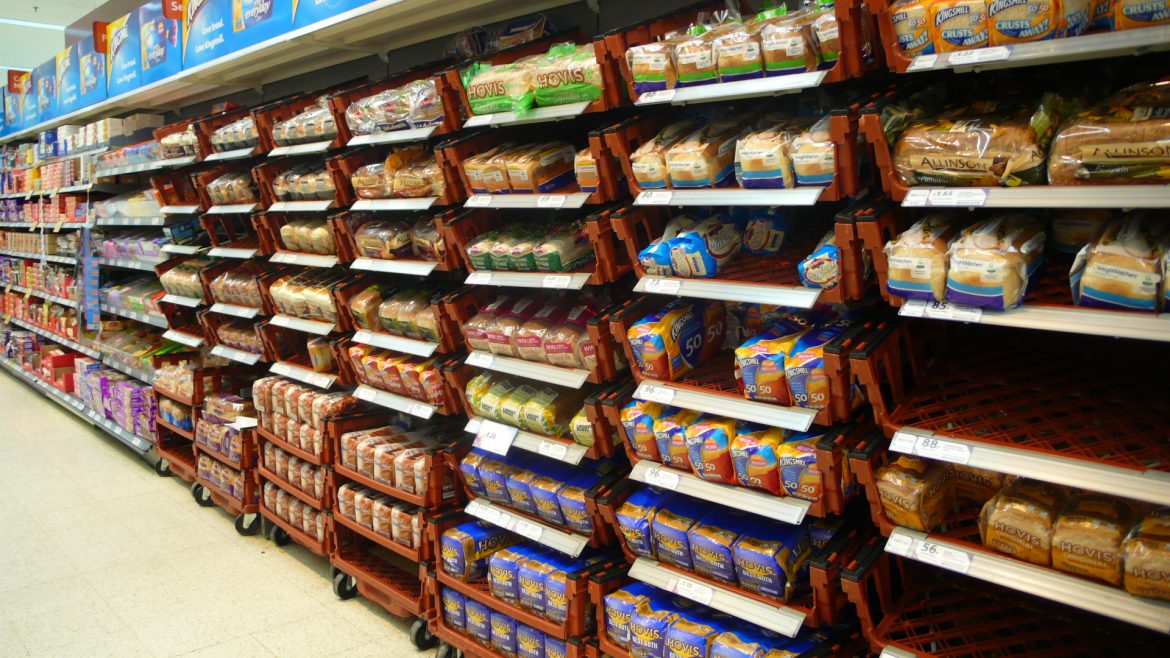
Every now and then I have a small noisy fit about the unnatural things they do to mass-produced bread over here. I see from Blog of a Bookslut that there’s just been an article in the Guardian that restates the heart of my rant with some interesting additions — including the suggestion that some of the present wave of gluten and yeast allergies can be laid at the door of the Chorleywood process.
I wouldn’t be even slightly surprised. Grr.
…Nothing to do by way of direct resistance but get out some of that super “primitive-grain” flour from BienManger.com in France and make bread the old-fashioned way. Cold rise, 48-hour cold rise sponge, crunchy crust, mmmm….
(Oh, and there’s a book, too: Not On The Label: What Really Goes Into The Food On Your Plate. The article is an excerpt from the book.)
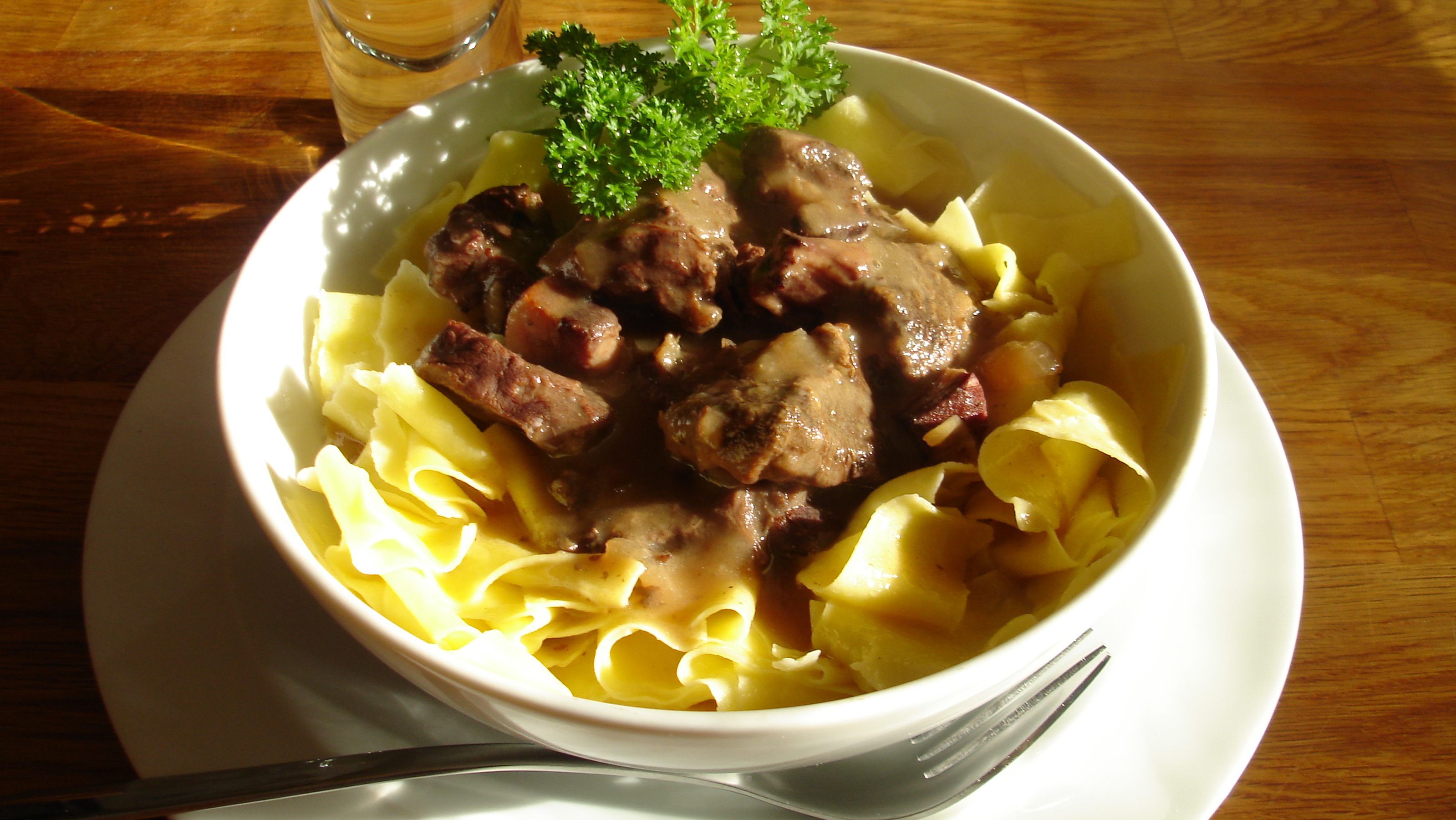
Autumnal weather is swinging through Ireland: the northwest wind is blowing, and the temperatures have dropped hard from the Indian-summer range we’ve been experiencing for the past couple of weeks. Last night was the first frost. So today there’s a fire in the fireplace, and the beef stew recipe below (properly, it’s a daube) is on the stove.
The recipe dates back to a time early in the last decade when I stumbled into that mysterious and useful French information system, Minitel. What brought me to the National Tripe Butchers’ site, I have no idea. But there I found two super things: a recipe for heart with garlic and red wine that produces the only genuinely delicious — indeed, the only genuinely edible — beef heart I’ve ever had (three days’ marinating in that harsh red wine and some balsamic vinegar seems to do the trick; when Queen Prezmyra says “O, I could eat their hearts with garlic!”, that was the recipe she had in mind…), and this recipe.
I translated it, installed it in my copy of the (now-defunct) Meal Master program, and set it loose on the Net some time back in MM format, posting it (I think) to rec.food.cooking. Then various disk crashes and restores caused my various MM databases to become less than complete, and the recipe went missing. Today, though, I went hunting for it and found it (stripped of all attributions) at a Chef2Chef resource that’s now defunct. No matter: I recognized my own recipe-writing style, and at least I found the thing again…
So here it is, restored to MM format for those who’re still using that. (I’ve switched over to Paprika myself: details here.)
MMMMM----- Recipe via Meal-Master (tm) v8.05

      Title: Shin of Beef Stewed in Red Wine
 Categories: Beef, French, Meat, Stew
      Yield: 6 Servings

      6 oz Smoked bacon or salt pork
      1 ea Large onion
      1 tb Olive oil
      5 lb Shin beef off the bone
      2 ea Cloves garlic
      1 ea Bouquet garni
      8 oz Red wine (or more)
      1 ts Salt
      8 oz Beef stock or water

  Cut the bacon or salt pork into small cubes and put them, with a
  tablespoon of olive oil, into a heavy and fairly wide iron or
  earthenware pot. When the bacon fat runs, add a large sliced onion
  and stir about until slightly brown. On top, arrange the shin of
  beef, off the bone, into thick pieces. Add the cloves of garlic,
  crushed but not chopped, and the bouquet garni (either one of the
  "instant" ones, or a small bunch of parsley, thyme and bayleaf, tied
  up with a string). Pour in a large glass of red wine (about 8 oz) and
  let all come to a fast boil for 4-5 minutes. Add about the same
  amount of beef stock or water, and allow to boil again. Add salt.
  Cover the pot with paper or foil and a well-fitting lid. Transfer to
  a very slow oven, 290 degrees F or gas mark 1, and in about 3 hours
  it will be cooked. Or you can half-cook it one day, remove it, and
  finish it the next. Serve with potatoes or rice to soak up the sauce.
  (Egg noodles also work well if you thicken the sauce slightly.) This
  dish can also be simmered *very* slowly on top of the stove.

MMMMM
This is a recipe for which the French verb mijoter was invented: that lowest simmer, at which the surface of the steaming liquid merely trembles and only the very, very occasional bubble rises to trouble it. After three hours, the meat has reached a tenderness that still has texture. But for this it really helps to have shin beef, which stands up best to the long cooking. If your butcher can’t get you shin beef for this, and you can’t locate a butcher who can, regular stewing beef will be fine. It just may go a little more to pieces when it cooks… but this won’t impair the flavor.
Enjoy!
(Caution: this blog entry not suitable for people frightened by the word “lard”)
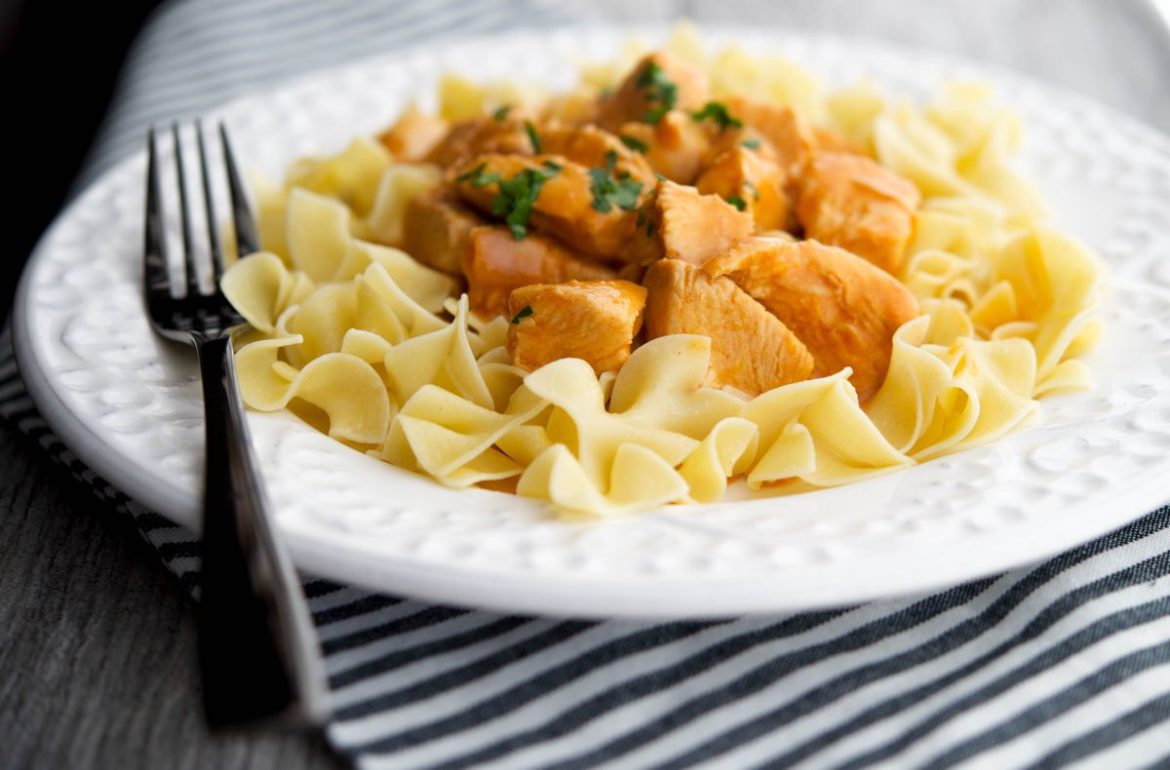
Title: CHICKEN PAPRIKASH
Categories: Main dish, Chicken
Yield: 6 Servings
MM#: 5645
1 Chicken; cut up, aprox 3 lb.
1/4 ts Pepper
1/4 c Butter (or marg.); melted
1 cn Chicken broth
1/2 c Onion; chopped
2 c Sour cream
1/4 c Flour, all-purpose
1/2 ts Worcestershire sauce
2 ts Salt
8 oz Noodles, med.
2 tb Paprika
Lightly brown chicken in butter in a skillet; remove and set aside.
Saute onion in pan drippings until tender; blend in flour, salt, paprika, and pepper. Cook over low heat until bubbly. Gradually add chicken broth; cook, stirring constantly, until smooth and thickened. Remove from heat; stir in sour cream and Worcestershire sauce.
Cook noodles according to package instructions; drain. Combine noodles and half of sour cream sauce; spoon into a shallow 2 quart casserole. Top with chicken; pour remaining sauce over chicken. Bake at 325 degrees for 1 hour.
100 g lard or shortening
120 g chopped onion
12 g paprika
2.1 kg chicken or 2.25 kg lamb meat with bones, or 1 kg boneless veal
salt
160 g green pepper
80 g tomato (fresh)
20 g flour
3 dl sour cream
(Paraphrase, since for method the recipe refers to one on another page:) Saute the onion in the lard, then the green pepper. Cut up the meat small and saute it with the vegetables. Add the paprika. When everything’s cooked, mix the flour with the sour cream and add over very low heat, stirring until the sauce thickens.
Okay, now I’ve seen everything. Ann Coulter has written a children’s book.
…Okay, it’s satire. Fine. I still need to go bake some more bread now.
…Oh, I found that rant I was looking for. Apparently the poster has archiving turned off on their posts, but I had the thing locked down in Agent.
Quoting “The Old Monkey”:
[The] Chorleywood process….was invented in the UK in 1961 as a way to greatly speed up the production time for a loaf of bread, and to enable the use of much larger amounts of British “soft” wheat in a loaf, making it unnecessary to import as much of the more expensive “hard” wheats from either Europe or North America — goals that, by themselves, made a certain sense at the time.
The process involves hyperagitation of the dough for about three minutes, incorporating air, which then raises the dough by being exposed for a short time to a partial vacuum.
A quote from the UK Baker’s Federation site below:
“Dough development in CBP is achieved during high speed mixing by intense mechanical working of the dough in a few minutes. Not only does this save considerable time (which helps keep down the cost), it also produces bread which is better in respect of volume, colour and keeping qualities.”
Yeah, but what about _flavor,_ guys? Or texture? …Unfortunately the Chorleywood process turns out a loaf that doesn’t taste anything like as good as a loaf which has had at least a couple of hours to allow yeast to work on it (the total rise time of a CBP loaf looks to be about an hour and ten minutes), or which has been kneaded at lower speeds and in which the gluten has been allowed more time to relax naturally (it’s allowed just eight to ten minutes to do this under Chorleywood). Indeed, CBP bread doesn’t taste of anything much at all, not even yeast (which acts more as a flavoring agent than as a rising agent in bread made by CBP, and I have a feeling the bakers would leave it out if they could: the main rising agent in CBP bread is the air that’s incorporated during the violent pre-rise agitation of the dough — this expands the dough during the vacuum stage). What the Chorleywood process does allow you to do is quickly and inexpensively turn out the cheap “pan” loaf beloved of large UK grocery chains, the stuff of price wars — bread that looks and tastes like white bathroom sponge. (Except bathroom sponge has more texture…)
(sigh) Is it a good thing for lots of people to be able to afford cheap bread? Sure. Is it still good if the bread is by itself so devoid of nutrition that it has to be “stoked” with enough folic acid and vitamins to approach the value of more slowly-baked bread? Hmm. Is it _still_ good if it doesn’t even taste like bread after they’ve finished sticking it full of flavor enhancers and stabilizers and the good God knows what else? Not by _my_ lights.
In the UK, Elizabeth David (in ENGLISH BREAD AND YEAST COOKERY) was the first to start complaining about the bread turned out by the CBP. Her essay on the subject nearly singlehandedly rekindled an interest in craft baking and home baking in Britain…
…For some different takes on the process, see;
Ireland is not terribly big on rye bread…at least not the kind I grew up with in the New York suburbs. I still remember the sour bite of the Pepperidge Farm Jewish rye that was my favorite in the 1960’s. While it seems to me not to have changed flavor that much between now and then, there are certain logistical problems associated with getting my hands on Pepperidge Farm rye (or any other US-based rye) these days: mostly, that it’s 3500 miles away across the Atlantic, and shipping it here in time for it to be worth eating is too damn expensive.
So I’ve been trying on and off for some years to (more or less) duplicate it at home. Until recently this has been a spotty business, complicated by ovens that have changed with each house we’ve rented — typically, I’d just start getting the hang of an oven when we’d wind up moving again — and ingredients which have also complicated matters. Ireland isn’t strong on the hard wheats that are good for bread: the climate here is too gentle to grow them well, so even the so-called “strong” flours don’t make the best bread in the world. Also, the texture was never going to be a perfect match no matter what I did: nearly any commercial bread available in the US is going to have a softer texture than a home-baked loaf due to the use of “improvers” and artificial rise-acceleration processes like the awful Chorleywood process. (See here for links on the subject. And here’s a copy of a wonderful rant on the subject by someone in, of all newsgroups, alt.books.tom-clancy.)
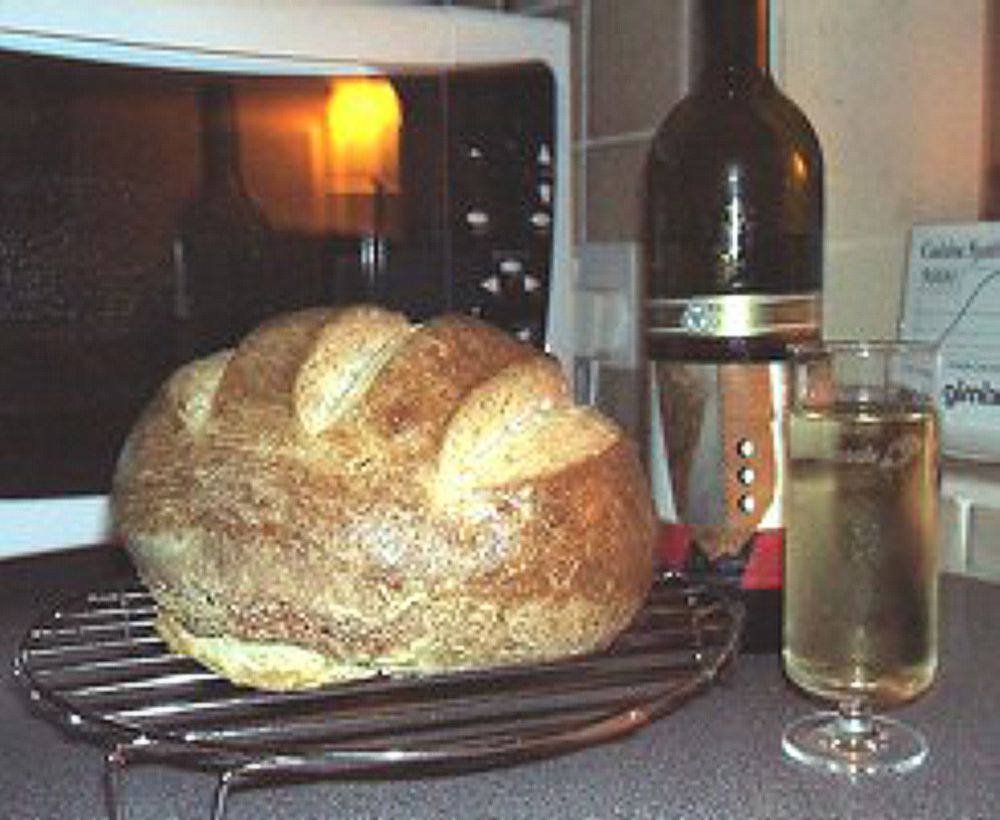
Nonetheless, I think I may have finally started to get pretty close on a regular basis. The new fan/microwave oven has helped — its fan oven’s really super. And working with live sourdough sponge, rather than dry yeast, seems to be another useful trick. As for the rest of it, there’s not a recipe as such, but just a general series of steps to follow:
.jpg)
And that’s it. Flour from Odlums of Ireland. Wine: 2001er Sasbacher Limburg (Weisser Burgunder) “Kabinett Trocken” from Weinhaus Dörflinger of Karlsruhe. Wineglass (actually it’s a champagne glass) from Crossair (gone now, alas…but on the flip side, how many “daughter” airlines rescue their parents, becoming them?…) Oven from Whirlpool. The rest is just physics doing its thing. …And life. (Let’s hear it for the yeast!…)
