
…or in other words, it’s February 2, 2016.
The book has its own website, as well as its own Tumblr and Twitter: you can follow its progress there.



…or in other words, it’s February 2, 2016.
The book has its own website, as well as its own Tumblr and Twitter: you can follow its progress there.

It was seeing this thing that got me thinking about the subject.
…WTF? RT @pattymo: Who will answer for this crime pic.twitter.com/u0h3jqCfIh
— Diane Duane (@dduane)
What surprised me after the fact was that the very sight of a “candy corn bar” provoked such a strong reaction from me (“EWWWWWWWWW”) despite my being long past trick-or-treating age.
This response poked me in the curiosity nerve, a little, so I went looking for evidence of whether other people shared anything like it — this idea that some Halloween candies were “right” and others “wrong”.
And a little research suggests there seems to be a bone-deep conservatism on this issue, combined with some regional implications, as various Worst Halloween Candy lists seem to have areas where they agree and then others where they diverge or disagree strongly. (As an example: lists at BC Living, HuffPo (in fact they have a few of these), TopTenz, Serious Eats, Complex, Nooga…) Google will guide you to more if you feel the need for a broader statistical sample.
I always took Halloween very seriously while I was still of participating age, as my family wasn’t particularly well off and there wasn’t that much candy in my lifestyle except at chocolate-heavy holidays like Easter and Christmas. (Fortunately I slipped out of this stage just barely before the OMG BAD PEOPLE ARE PUTTING RAZOR BLADES IN THE APPLES thing got started.* I didn’t mind the apples. I knew they were traditional.) (As they still are in Ireland, which is after all where it all began. Apples and peanuts have been the trick-or-treat staple here for many years: only now are the candies starting to creep into the Irish tradition.)
So for what it’s worth: looking over these lists, I find some common ground, but not complete agreement.
Stuff I liked:
Stuff I had no time for (and would swap with others who liked them):
Seasonal considerations: There were things I had no time for at Halloween because they were readily available at other times from the store up around the corner on Park Avenue:
…Anyway. Enough of this: I haven’t even had all my breakfast yet.
(Meanwhile, for those of you who’re feeling nostalgic: have a look at OldTimeCandy.com. They have the stuff arranged by decades.)
*Has anyone ever actually found a razor blade in an apple? I mean, verifiably? With pictures? Or is this one of those Urban Myth Coinciding With Early TV/Mass Media Attention Causes Hospital X-Ray Departments Nationwide To Waste Millions Of Person-Hours On One Day Each Year things?
(See also People Being Gassed In Sleeper Compartments of European Trains And All Their Stuff Stolen. I went hunting for non-anecdotal data on this some years back and couldn’t find anything. My firm belief is that back in the day, numerous weary and stressed-out travelers were careless / clueless about making sure their sleeper compartments’ doors were actually locked before they went to sleep, and then desperately needed a face-saving excuse the morning after opportunistic thieves, or in some cases their fellow sleeper compartment occupiers, had ripped them off while they slept through it like the dead. “I mean, I’m a light sleeper, I would’ve heard anybody come in unless something else was going on. It must have been gas! Gas!” …But I digress.)

That’s my year made.
phaser, n.
2. Science Fiction. A weapon producing destructive laser or similar beams (of variable phase); spec. a (usually hand-held) device whose output can be varied to produce different effects on a target (as stunning, annihilation, etc.). Also in extended use and in figurative context.First used in the U.S. television series Star Trek.
1966 G. Roddenberry Memo 26 Apr. in S. E. Whitfield & G. Roddenberry Making of ‘Star Trek’ iii. i. 272 Reference the mating of various components of the phaser weapons..when the hand phaser is mated to the pistol, they should appear as one weapon.
1967 Pop. Sci. Dec. 73/2 The main weaponry of the Enterprise is its banks of ‘ship’s phasers’,—artillery-size versions of the hand phasers and phaser pistols carried by the crew. These weapons are, of course, refinements of today’s familiar lasers.
1978 D. Bloodworth Crosstalk xxxiii. 256 The USAAF had brought down the first unmanned plane with a laser, and..had..been thinking in terms of light, chemically-operated versions that could be phased together… ‘Phasers?’ ‘Phasers. Right.’
1984 D. Duane My Enemy, my Ally vi. 85 Mr. Chekov, arm photon torpedoes, prepare to lock phasers on for firing.
1995 THIS Mag. July 21/2 His oddly reserved nature stands out… Whyte sets his phaser on stun, not kill. In print and in person, he usually gives a nod to his opponents before letting fly.
2000 Personal Computer World Dec. 481/2 The phaser rifle..easily vaporises most opponents in a spectacular orange echoey screaming fashion with a single shot.

The formal acceptance of the International Association of Media Tie-In Writers’ Grand Master / Lifetime Achievement Award at SDCC 2014:
I want first of all to thank the IAMTW for honoring me with this award. I don’t think of myself as particularly grand, and mastery is a goal I’m usually convinced is a long way off; but it’s nice to be disagreed with so publicly.
I really hate it that I can’t be with you to accept this. But work at the European end of things is keeping me at home, and I’m pretty sure that that incredibly prolific and committed storyteller Frederick Faust, who wrote as Max Brand and under so many other names, would back me up in saying that the work comes first.
In any case: in accepting this let me chiefly thank the readers, fellow writers, and editors who make it so very worthwhile. You’re the ones whose constant support and friendship over many years have proven that the challenge of working in other people’s worlds is far outweighed by the privilege and pleasure of it — and that playing in those extramural universes, as long as you give your all to the storytelling, is just as honorable and fulfilling a way to spend your life as playing in your own. To my fellow pros and the fellow fans in all the worlds where I work, canonically or otherwise, all I can say is: thanks again, and (until I kick the present project out the door) I’ll see you online! (@dduane)
I’ve really been intensely unhappy that I wasn’t going to be able to be in San Diego to speak the above words myself. There’s much to be said for knowing you’ve won an award before the fact — especially that you don’t have to sit there in a roomful of people twitching about what might or might not be about to happen. I’ve done that a couple/few times, and I can’t really recommend it. Scrubbing in on brain surgery has freaked me out far less.
But stress issues aside, there’s also considerable pleasure in merely having this kind of work acknowledged. A lot of professional writers are ambivalent about doing novel work that’s based on films or comics or somebody else’s storytelling in some other medium — often a more visual one, or one positioned higher up on the media totem pole. (Since there’s been an unspoken perception among creatives for a long time now that film beats TV, TV beats music, music beats any print medium, and so on down the line, with new forms of visual media squabbling amongst one another as they try to wriggle themselves into the longer-established peer structure.) There are writers who avoid such work because they feel it’s beneath them, or because other people will assume that they’re only doing it for the money – not that the money’s routinely all that great, if the truth be told. Or else they’re afraid that people won’t take the work (or them) seriously if they do it.
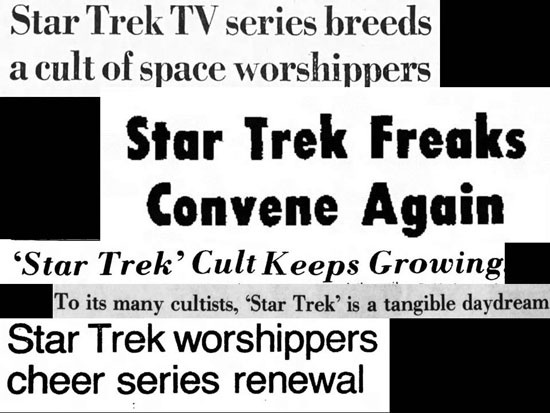
How the newspapers of the time saw the Star Trek revival
I would not be one of those writers. My experience is that if you as the writer treat the work seriously, it will be taken seriously… at least by anyone who takes the time to judge it on its own merits rather than their own preconceptions. (And if someone won’t do that, why would you care what they thought?) As a result I’ve spent a significant portion of my life working hard in other people’s universes, and the only reason I do that is because I feel strongly about what’s come out of them in the past, for good or ill or sometimes both. Routinely, this is not work I get into unless there’s something I really love about the source material.
Star Trek would be the best example of this, of course. I loved it from the moment it turned up on the screen, and I loved it after it fell off the screen into what (up until then) for any other series would’ve been a fairly quick oblivion. But Star Trek had a couple of things going for it that other TV shows hadn’t had until then. It had content that could be syndicated afterwards (for which we have the inimitable Lucille Ball to thank: Desilu, the production company that she ran with her husband Desi Arnaz, invented the concept of syndication.) But more than that, it had a committed, passionate and quick-witted fandom that refused to let it die. They saw — as I saw — something in Star Trek that in terms of its storytelling and its vision was too good to lose. It was that too-often-indefinable thing that makes you want to keep on hearing (or seeing) the stories. This is in its way the purest and most basic of fannish impulses… the gut-deep response to a world you come to love so much that you want to become a part of it, no matter what that looks like, just so long as it keeps going.
In my case it would never have occurred to me in any dream, regardless of its wildness, that the Trek fan fiction I wrote in my late teens was laying the groundwork for other fiction that would eventually plunge me into the media-based fiction world. Or that I’d wind up working right back in the Star Trek universe that I’d loved for so long, and eventually — though much later — in canonical Trek as well. Both sets of circumstances sent me off down kind of a crazy zigzag career path, dizzying sometimes as a switchback road race in the Alps… but the views have been fantastic. On one side, I’ve written for Jean-Luc Picard and Batman and Siegfried the Volsung and Scooby-Doo. On the other, I’ve written novels based on comic characters, novels based on computer games, novels based on RPGs, and most of all, novels based on TV shows — some just being born, some long active, some long defunct. But in all cases they’ve been properties that I’ve been fond of. So maybe if there’s a message here, it’s that for maximum effect — and certainly, maximum satisfaction at your end — you should write about things you love.
That doesn’t mean that while you do it you should lose sight of the economic realities. One very gifted tie-in writer of my acquaintance used to refer to some of his work by sobriquets such as “Conan the Hot Tub”, “Conan The New Roof…” You do your best to make sure you do your work in places that you not only love, but that are going to pay you a decent wage and treat you honorably. Because the work itself is honorable. There is nothing wrong with writing straightforwardly to entertain, and you have (and should never be afraid to claim) the right to take your payment afterwards with a clear conscience and walk away with your head held high.
…Always assuming you’ve done the work as well as you can, and work to do it even better the next time. The writer who incorrectly assumes that because you don’t own all the rights to it, this is work you can take fewer pains with or “phone in”, won’t be doing this kind of work for long… because the readership will smell it on them, and word will get around. If you’re going to take what we refer to around here as the King’s Shilling, then you must stay bought for the duration of your contract, and give it your full attention and effort. Your unwritten contract with your readers, who’ve spent what Robert Heinlein used to call “their beer money” on your words, demands as much. Fortunately, the more you write, the better you get, as a rule… and the Work For Hire does you the favor of honing skills that will later be turned to your own work, all the sharper for the extra use.
Anyway. Lately I haven’t been doing that much work in other people’s worlds: original writing both at the film and prose ends has been keeping me busy. But my tie-in work has been a great joy to me — the source of much fun and many friendships and (last but most certainly not least) even a factor in the events that led me to the man who married me, and who’s sometimes since done tie-in work at my side. (That Star Trek novel that we wrote on our honeymoon? There’s a statement of commitment if you needed one. It’s not like we didn’t have other things to do.) 🙂
So to have that work so acknowledged is a tremendous pleasure, one I accept with thanks.
And it’s not as if there isn’t just one more Trek novel lying around in the back of my head, waiting for other work to get handled so that I can find out who I need to talk to at Pocket Books these days…
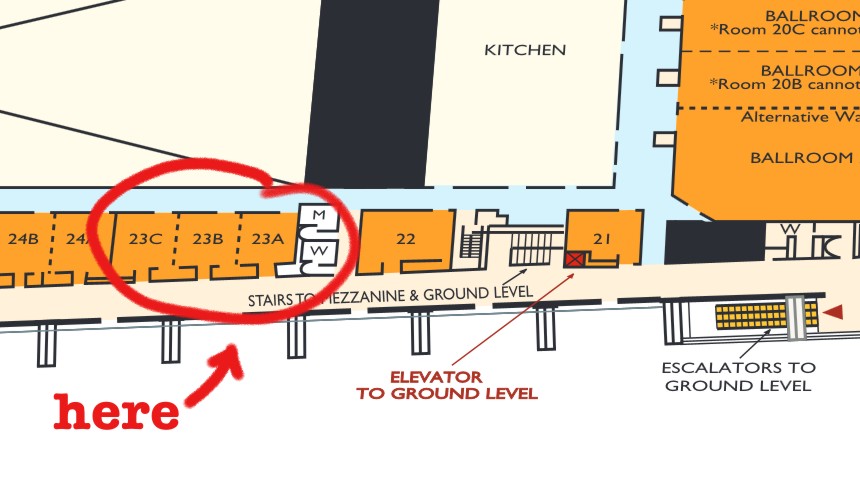
…even though I won’t be there. (Work is keeping me home, unfortunately, as well as a medical issue or two. )
Just a quick note about this.
We ship all signed hardcovers and paperbacks by registered mail / post to prevent losses in transatlantic shipping. (There were a whole lot of losses before we started doing this. Now it’s very, very rare to lose a book in transit, as registered mail pretty much keeps a given shipment under lock and key until it leaves your local post office.)
As of July 21st, the Irish postal system, An Post, has increased its rates across the board, and registered mail costs have therefore gone up slightly as well. As a result, all our physical books’ prices are going to have go up slightly too… as (to simplify things) we normally set an all-inclusive worldwide shipping cost for each book, and include it in the book’s price. Our apologies for the increase.
Meanwhile, the physical-book side of the store will be expanding considerably in the next week. There’s only so much storage space in our little house, and Peter and I have jointly decided that we may as well do something proactive about all our authors’ copies. Neither of us can see why we need more than a couple copies of each edition. But each of us has, for the most part, ten copies of every book we’ve written, in every edition, sometimes more… and with sixty-five-plus novels between the two of us, honestly, who needs all those? There are hundreds of them around the house, taking up room that could be occupied by…well, by more books. Ones we didn’t write.
So the tiny “boot room” at the back of the house, normally full of exercise equipment, laundry paraphernalia and gardening junk, is being reorganized to house all the books we don’t need as we prepare to sell them off. These are almost all in mint or near-mint condition and will come to you signed and personalized. Some of these books are quite, quite rare and impossible to find through the normal used book channels, in this or (in some cases) any condition. So if there’s something in the way of a physical book from one or the other of us you’ve been looking for, this would be the time to bookmark this collection page — which lists all the hardcovers and paperbacks on offer — and visit or revisit it occasionally over the next week or two.
You can also add this URL to your favorite feed reader, if you like. It’s the Atom feed from the hc/pb collection page:
http://ebooksdirect.dianeduane.com/collections/signed-hardcover-and-paperback-books.atom
Please note that this feed will show you books that are out of stock but might come back in again. Not until we’ve dug through all the various storage boxes and extracted all the books from them will we be absolutely sure what we’ve got, and this will take a while. In some cases we know already that all the copies of a particular book are gone gone gone, and when we know that, we’ll remove the book’s page completely from the store. Until that happens, though, its listing will be allowed to remain in the store but will show “SOLD OUT” in the order button. (I’m going to add another “only show books in stock” feed if I can get the store’s logic to do that.)
One word of warning. Normally we give notice by a posting on Twitter or at my Tumblr when an unusually rare book becomes available. When this happens (especially if it’s a Star Trek book, it seems) whatever inventory we have is normally gone within hours if not minutes. So if you see something you like, seriously… don’t wait around. Move fast. There are some truly committed collectors out there.
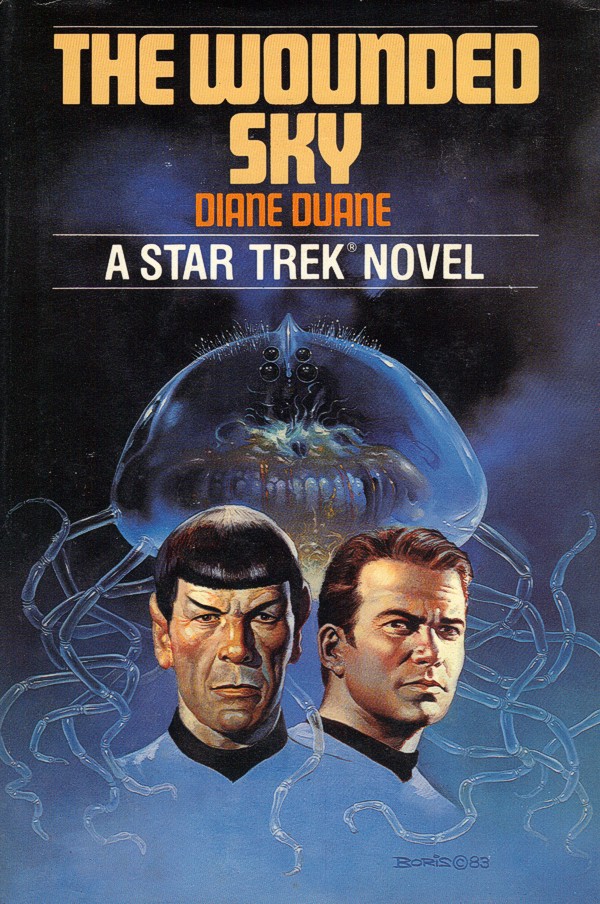
And just to complete this train of thought: I was going through a box that seriously shouldn’t have had any books in it and found, tucked away in a corner, two copies of the 1983 SF Book Club first hardcover edition of The Wounded Sky. (Cover by Boris Vallejo, who was apparently unclear at the time that this was a glass spider we were working with.) Not incredibly rare, but very hard to find in good condition. I think there are more, but here are these two copies for those who might want them. Price, as always, includes postage, packing&handling, and signing & personalization.
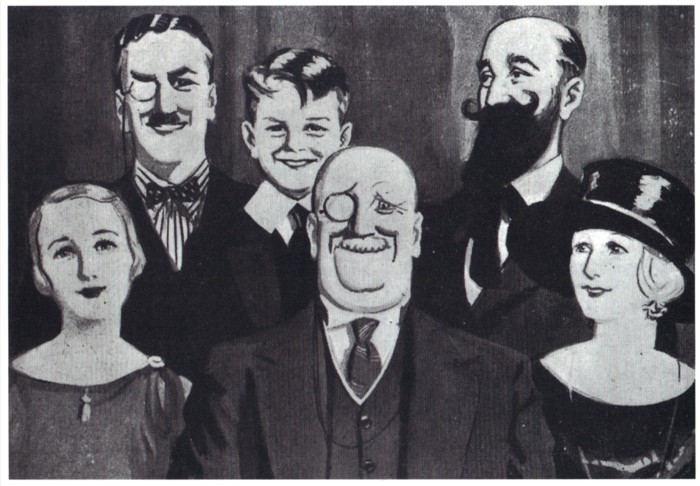
The main officers of the Mustard Club. From left to right: Miss Di Gester (secretary), Lord Bacon of Cookham, Master Mustard, the Baron de Beef, Signior Spaghetti and Lady Hearty.
Poet, novelist, playwright, translator, essayist, Holmesian: there is a lot to know (and like) about Dorothy L. Sayers. This I didn’t know, though: her first writing that made a real splash was part of her early career as an advertising copywriter for the London advertising agency of S.H. Benson*. And in this mode she was possibly one of the first participants in a campaign of guerrilla advertising, and one of the earliest examples of an integrated advertising campaign. It ran for seven years — which is a good long time for any ad campaign, then or now — and worked its way deep into the fabric of UK popular culture of the last century.
It started when mysterious posters began to appear inside and outside London buses and then in buses and on advertising hoardings elsewhere around the country. These posters said, simply, “Has Father joined the Mustard Club?” Mystified, people started talking about them. Gradually other aspects of the campaign began to emerge: newspaper ads and magazine articles about the Mustard Club and its members.
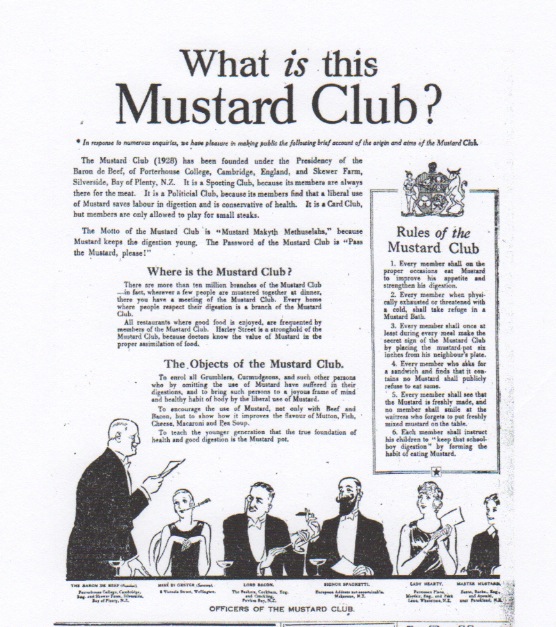
There was a club newsletter you could subscribe to (apparently Sayers wrote this as well) and club badges that you could send for. By the time the club closed in 1933, half a million of these had been sent out: in mid-campaign there was an office staff of ten people who did nothing but handle the two thousand badge-requests that came in each week. There was a recipe book for which Sayers did the writing (still on sale at Colman’s Mustard Shop and Museum in Norwich: though original editions are still to be found, and must be fairly collectible, to judge by the prices…). There were even spoof newsreels about the doings of the club, and numerous marketing spinoffs — among them playing cards and (no surprise) mustard pots. All through the campaign, a lot of care was taken to make the club seem real, even if (as our copy of A Dash of Mustard
…So that’s today’s Thing I Didn’t Know About. The only problem with doing this particular kind of research is that it’s now made me hungry for something I can put mustard on. (sigh) A good thing it’s lunchtime…
*It turns out she was also responsible for the tremendously popular Guinness “Zoo” ads, with art by Gilroy (who was working for the same London ad agency), and wrote the well-known poem for the Guinness Toucan:
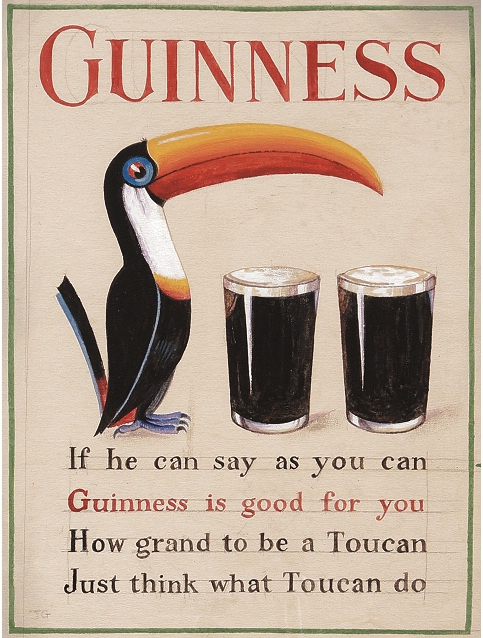
If he can say as you can
“Guinness is good for you”,
How grand to be a toucan —
Just think what Toucan do!



In the “Something’s A Bit Wrong With This Sentence” department…:
“A Seattle man burnt down his house on Tuesday after trying to kill a spider that he found in the laundry room with a homemade blowtorch.”
This was crossposted from DD’s tumblr http://ift.tt/1jAG8jV, where it was published on July 17, 2014 at 09:51AM
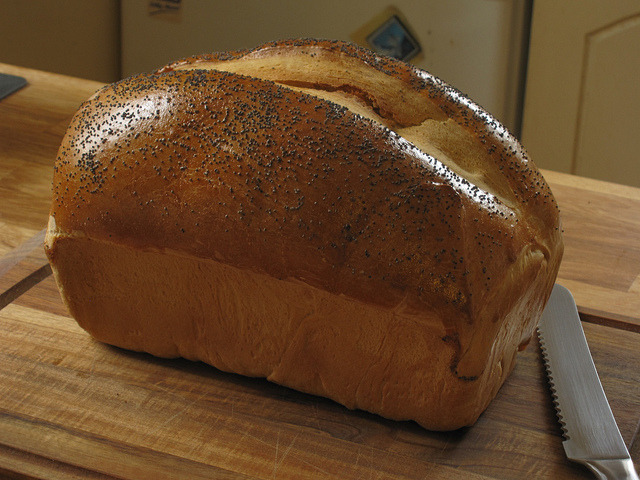
So last night I was working late-ish, and it occurred to me that this would be a good time to bake some bread. In particular I wanted to test the Odlums “strong white” bread flour to see how it behaved with the enhanced white bread recipe* I’ve been playing with, and how it stacked up against the Hovis “super strong” bread flour that I normally use.
The making actually only takes abut fifteen minutes: throw the ingredients together, then knead for six minutes at slow speed with the dough hook and six minutes at higher speed. Put it in a greased bowl, walk away. Back to work.
…Or theoretically back to work. When I sat down at the machine again I had a quick look at my Twitter feed and saw this:
Pencil structure. 8.6 x 7.3. 2014. Really? I’ve drawn comics all these years so I could draw a squirrel? Really? pic.twitter.com/J3UqrL6m1V— Walter Simonson (@WalterSimonson) July 15, 2014
Two things immediately occurred to me: (a) this was someone I had the pleasure of meeting way back when and hadn’t crossed paths with since, and (b) that was one mean-looking squirrel. So I tweeted him and we got to chatting.
And I forgot all about the bread, having (a little earlier) punched it down and shoved it in a loaf pan. (Forgot about the work, also, for the moment. But the bread was more likely to get stroppy in the very short term.) When I went back in the kitchen it was climbing out of the loaf pan in a very determined way. (Seriously, it shouldn’t get that high before you bake it…)
Anyway, it all came right in the end. This is how that loaf came out…
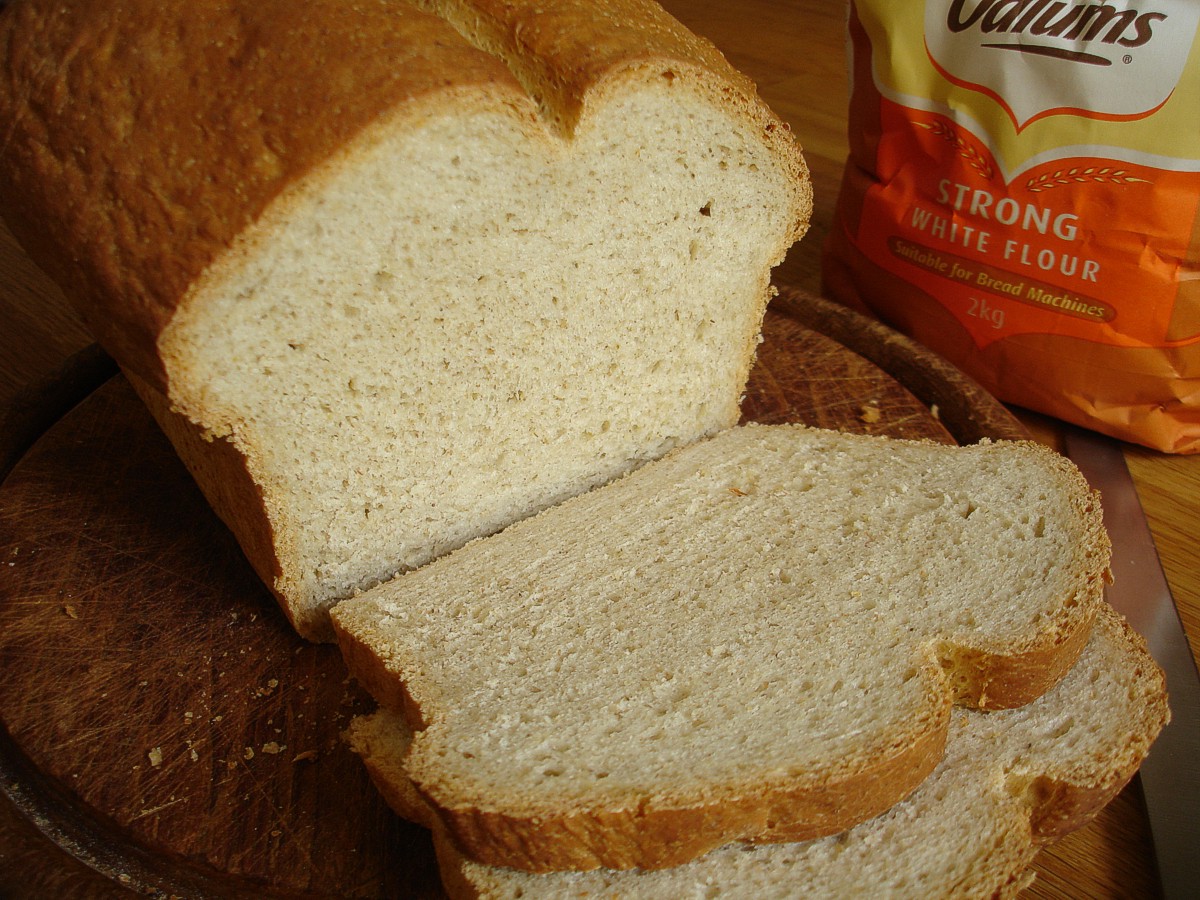
Not too bad. Taste testing comes later in the day.
*The enhancement: add 50g of oat bran and 50g of wheat germ to the basic Tessinerbrot recipe. This produces a bread in the “soft white/whole wheat” category beloved of marketers trying to get some kind of wholegrain content into breads that don’t look like they’ve got any, so that kids will [theoretically] eat them.
(See also this entry. I think this may have the wrong picture attached to it: seriously, this bread always rises like crazy.)

 The song that contains the line above was originally famous for having come from the great Rodgers & Hammerstein musical Carousel, and is now much better known on this side of the water for its association with two great British football clubs (after the Gerry and the Pacemakers cover of it came out: you can hear it below). And the song is about as close as most people are likely to get to a real lark, these days, as the Eurasian skylark is just about the single most endangered bird in Europe. Nevertheless it was over the field above that I heard one the other morning when I was out walking. It stopped me in my tracks: it’s been easily a decade since I last heard one. And who knows if I’ll ever hear one again? The changes in their nesting areas (mostly open fields) in these islands have reduced their numbers by almost 90%. I hope they can hang on. It would be sad to lose that uprising song forever.
Oh God the tables have turned please do not put me in your pants I am sorry I put you in my pants
I think I’d probably better stop reblogging these right now. Having enough trouble breathing right now as it is. 🙂
This was crossposted from DD’s tumblr http://ift.tt/1nsxMGf, where it was published on July 15, 2014 at 03:58PM