
It was a charming convention. I look forward to coming back some time (with Peter, this time).
Stockholm is a city I look forward to visiting again when I have more time. The light here is very special. (The dark, not so special. Or maybe it is, but I’m a little set against it at the moment, as last night I got off the T-bana / Metro on the wrong side of the square at Odenplan, and (having set off confidently in the wrong direction) spent the next three-quarters of an hour (a) walking around in the dark and the rain (b) while trying to read the city map (c) and trying not to look like I was reading the city map in the dark, in the rain (d) while being ten blocks from where I should have been. No matter: I backtracked and found where I should have been.)
(It’s funny today. Last night, not so funny. But eighteen or twenty-four hours puts everything in perspective.)
Meanwhile, preparatory to heading back to my hotel, I find myself sitting in Gamla stan / the Old Town… in an Irish bar. They just happened to have (a) whiskey and (b) a ton of open outlets in the front of the place where I was able to plug in the computer and the phone. 
Home tomorrow. Which is good, as I miss the computers, and the cats. And the husband. (Feorag, also NB: you have fans up here, and Fluff is kindly spoken of.) But in the meantime — thanks to all the Stocon folk for a memorable weekend. (And the cookbooks are brilliant, guys. Thanks again.)
So here I am. Missing Peter (inevitable), enjoying the weather (hot, sunny, a touch humid), and working (also inevitable: Vasa is going to have to wait for the next trip, I’m afraid).
The eclipse passed without notice in most parts of the city, I think. (But at only — what, 30%-ish totality? — this is forgivable. I think I noticed things getting a little dim this morning, but there was some cloud cover passing through at the time, and people no doubt attributed the change of lighting to that.)
Meanwhile I am holed up in a comfortable bar/restaurant called the Järntorgs Pumpen, finishing work on the film outline and watching other, more normal people sitting out in the sun in front of the restaurant and enjoying themselves. Having had a nice cool tuna salad, I then started a cyberskulk (i.e., a hunt for powerpoints / outlets) and was delighted to find outlets to charge up both computer and cellphone just a table away. (Future visitors, NB: it’s the table for four inside the window on the left as you face the restaurant from the square: the outlets are between the table and the front door.)
Here’s the view from where I’m working:
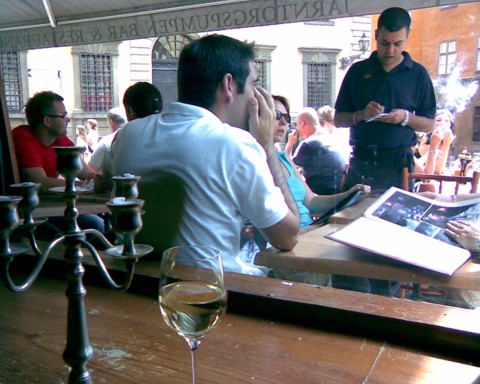
(Dublin readers: imagine my surprise to find a bar/restaurant called “The Temple Bar” just around the corner. To my surprise, the menu was mostly Greek. Go figure.)
Specifically, for online pick-your-own-ingredients-and-we’ll-ship-it-to-you muesli.
From this week muesli lovers in the UK will be able to order their very own custom made cereal choosing their ingredients online.
The German firm ‘Well’ launched www.mymuesli.com last year and it has proved successful in its homeland. Customers are able to use the website to dream up their personalised breakfast choosing from 70 organic ingredients.
Now the firm is to launch its enterprise in the UK.
According to the company, the concept is: “Ideal for gourmets, raisin haters, allergics, athletes and die-hard greenies.”
Customers pick and mix their own ingredients from the choice offered on the website. The price of one 575 gramme tube starts at £3.90, although the price can vary hugely depending on the rarity of the ingredients.
Yeeeeuuurrrrrrrrgh. What was this cake designer thinking of???
If I found myself at a party where that was sitting on the buffet or whatever, I would seriously consider leaving.
(shudder)
(Whereas this one merely looks like it wants to land at Area 51 or something.)
Peter was riding over to the next town to pick up a couple of things yesterday afternoon when his bike’s chain broke and he went over the handlebars and came down in a friendly hedge. (“Friendly” only because it broke his fall and there were no nettles in it.)
He’s okay, thank heaven. (“Shaken but not stirred,” he said when calling in.) His injuries from that passage at arms were fortunately minor — though the spot where the point of his bike seat caught him just behind, uh, a region of vital interest to males generally, is apparently pretty sore.
You should see his poor fingers, though, from where he hit himself with the hammer while fixing the bike chain on his return home. Ooooooooh boy. Peter will not be typing today, I think. Or maybe tomorrow. Meanwhile, I think I get to make him chicken soup on general principles.
However, I’m out of matzoh meal for the requisite M-balls. Now I’m idly wondering whether it’s possible to produce a slightly similar effect with semolina, as I seem to have a lot of that on hand for some reason. The Austrians, after all, do a griessknoedel or soup dumpling based on semolina. Hmmm….
(OMG, look at all the links to dumpling recipes on this page. NOM NOM NOM!)
The uranium content of granite has always been somewhat in our radar since we moved to Ireland, since there’s a lot of granite in Wicklow; and where there’s granite, because of the decay of the tiny amounts of uranium it often contains, sometimes there’s radon as well. But here’s a side effect I hadn’t given that much thought to.
As the popularity of granite countertops has grown in the last decade — demand for them has increased tenfold, according to the Marble Institute of America, a trade group representing granite fabricators — so have the types of granite available. For example, one source, Graniteland (graniteland.com) offers more than 900 kinds of granite from 63 countries. And with increased sales volume and variety, there have been more reports of [radioactive] or potentially hazardous countertops, particularly among the more exotic and striated varieties from Brazil and Namibia.
“It’s not that all granite is dangerous,” said Stanley Liebert, the quality assurance director at CMT Laboratories in Clifton Park, N.Y., who took radiation measurements at Dr. Sugarman’s house. “But I’ve seen a few that might heat up your Cheerios a little.”
Eek. I do not want my Cheerios heated up. Not even slightly!
One more thing to think about for when we redo the kitchen…
We’ve been idly looking for something to replace our old rusty hibachi. This looks like a nice possibility. It’s British (but the sales source is in the US: must see who’s carrying it locally).

The grilles both swing in and out and are height-adjustable (with the big one, the swing facility this means you can add charcoal or wood chips or whatever without fuss). The ash box underneath has a handle and pulls off for emptying. The chopping board is bamboo. Behind it you can see the utensil hooks.
Very neat!
This ad apparently premiered in Europe a couple of days before my birthday, and the minute I saw it, I fell in love with it.
The love falls roughly into three parts: (a) The basic conceit of the ad. (b) The nuts and bolts of the production (i.e., working out how much of the construction really happened and how much only seems to). (c) Some of the little details (the [licorice?] windshield wipers and fan belt, the gelatin brakelights, the royal-icing detailing, the guy pouring golden syrup into a gingerbread crankcase…).
Altogether a yummy piece of work, and the ad agency should be proud of itself / themselves.
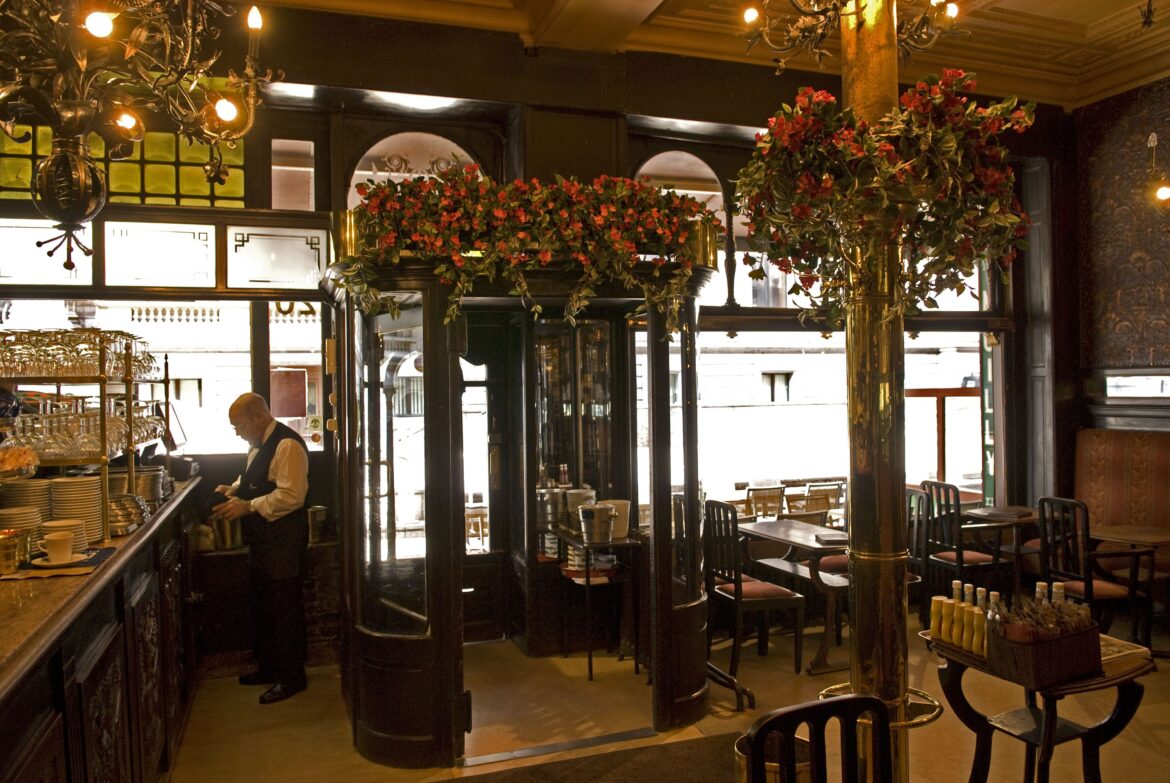
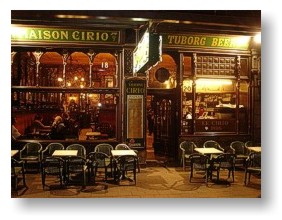 I mentioned this place in passing in a post some while back, and it really needs to have something more said about it, as there’s not nearly enough information online.
There are a lot of nice estaminets and bars in Brussels, but this one’s a favorite one for both Peter and me. Other such places will have more beers, or more food, or both; but none will so perfectly give you that “timeslip” feeling of having stumbled into another century. And there’s a cat. (And she’s a nice one.)
Le Cirio is the last remainder of a whole chain of restaurants founded by Francesco Cirio, a food entrepreneur who started the industrial farming and production of tomatoes for canning purposes in the mid-1800’s: the direct descendant of his company, now a multinational, still cans and ships GM-free tomatoes worldwide.
This branch of the cafe/restaurant was built in 1886, possibly one of the last in a series of eighteen establishments meant to serve as “tasting gateways” for Cirio’s products (there was always an industrial warehouse for the products nearby, and such alliances of Cirio-shop-and-warehouse existed as far away as New York, Berlin, Paris and London). All the others are gone now, but this one has resisted anything but the most minuscule changes since it was built. It is famous as the home of the half en half, which (for North American readers) has nothing whatsoever to do with dairy: it’s white wine and sparkling wine mixed one-to-one, a combination that may sound weird at first, but actually works very well.
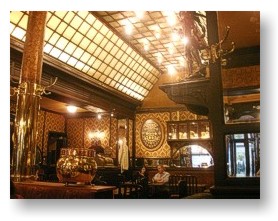 The cafe itself is a splendid den of perfectly preserved Art Nouveau: stained glass, ornamental brass, carved wood and marble-topped, iron-legged tables, with toilet facilities that are also gorgeously antique. Some of the wall hangings or tapestries are a little faded, the old mirrors a touch spotty: no one cares. The pace is leisurely. The music is — if not exactly 1890’s — also of an earlier time, more likely to be Piaf if anything else. People sit, have a coffee, drink, read their newspapers, chat, have a sandwich, gaze out the windows at the old Bourse building outside.
The first time I stopped in here, it was because Minou was doing that very thing. I mean, of course, “le Chat Minou,” the official Le Cirio cat, who lives in the apartment upstairs. Minou (it’s a French word for “kitty”) was tucked up in meatloaf mode on top of the espresso machine — plainly a smart move on a cold wet day — looking out at the pouring rain, eyes half closed. I was out and about looking for a cafe to write in, and I saw Minou and thought, “Why am I not in there?”
I went in and spent some happy, relaxed hours writing. I’ve been fairly often since. It’s not a big food place: mostly they have little sandwiches and such. (I like the croque monsieur.) Waiters in the traditional long white aprons patrol the room in a calm and alert way. Little old ladies drink the classic Belgian beers like Duvel. No one pays attention to one more writer working on a movie or whatever: they get that kind of thing all the time. The place fills, empties, fills again, all in an overarching sense of calm.
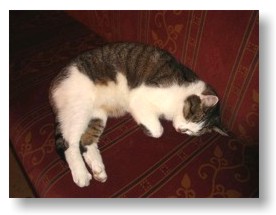 At quiet times, Minou appears to check the spaces underneath the tables and see if anyone’s dropped anything nice. She is not one of those in-your-face, demonstrative cats: she is willing to be friendly if you feel like paying attention to her, but otherwise entirely willing to let you be. On a cold day, she’ll jump up behind the espresso machine again to take advantage of the uninterrupted view out the window. It’s all very sedate, just a short walk away from the noise and expense and tourist-trampling of the Grand Place.
So recommended. Stop in and have yourself a beer.
Le Cirio | 20 Rue de la Bourse | Brussels / Bruxelles | Open: daily, 10am-midnight.
No credit cards
(link to Google map at Wallonie Tourism website)
A side issue: just outside the front of the restaurant/bar, a little off to the right as you look out,are the glassed-in foundations of a medieval church and convent, unearthed by archeologists in the 1980s.
(Also: Probably I shouldn’t be surprised that the only comprehensive article on the Web about Le Cirio is in Italian, at their version of the Slow Food site.)

“Lots and lots and lots of heart.” …Well, one anyway.
Our local craft butcher is sufficiently old-fashioned and down-country that the less commonly seen meats still make a strong showing — remarkable (in the older sense of the word) in this time when Ireland is prosperous, and many people are turning their backs on memories of an economically difficult past. So we’re still able to get a lot of things that characteristically get lumped together in that vaguely uncomplimentary category, “variety meats”: among others, oxtail, whole tongue, sweetbreads, and my favorite of the whole lot, heart. (It’s beef heart I’ll be discussing here, though our butcher normally has lamb and pork heart as well.)
Too many people have this image of heart as an organ meat, vaguely icky and wobbly. This is just silly. Heart is a muscle meat, like steak: just a whole lot harder-working. Or else people think of it as something incredibly tough. Often this is the result of having eaten heart cooked by someone who didn’t know how to treat it. Like oxtail and shin, it comes from a hard-working part of the cow, and like them, it needs long slow cooking to bring out its best. But when handled properly its flavor compares favorably with theirs, or surpasses them.
Now then: recipes. There are some heart recipes out there on the Web, but there’s a lot of duplication, and in my opinion most of the originals aren’t worth much. Heart just doesn’t have the cachet of other types of beef (and there would also probably be people who think of it as “poor person’s food” and want nothing to do with it). However, I’ve got a heart recipe that’s worth passing on.
Some years ago the Irish phone company introduced Minitel here to see if it would become as popular as it had in France. This was just before the Web started to become readily accessible, and when that happened, the Irish version of Minitel promptly went under. But for a while we had a Minitel terminal, and over a year or so of using it I started investigating what culinary resources might be found on the network. And at some point or another I stumbled onto something fascinating: the Minitel site of a regional tripe butchers’ association. The site of Les Societé Anonyme des Tripiers de wherever had a recipe section: and there I found one of the best treatments for heart I’ve ever seen. It being France, much red wine is involved. (Surprise, surprise.)
When I saw a nice-looking beef heart at the butcher’s a week or so ago, I nabbed it and brought it home, and then started hunting through the computer for my disk version of Peter’s translation of the original recipe. I can’t find it. It may have been destroyed in a disk crash, or gotten itself shoved into an ancient .arc or .arj file that’s become corrupt. But I remember the generalities well enough, and the basic method is worth passing on.
“False friends! O, I could eat their hearts with garlic.” (Queen Prezmyra, The Worm Ourobouros)
(She’s a gourmet if nothing else, that lady.)
First go buy a beef heart, and then find your boning or filleting knife.
Trim off any exterior fat from the heart: you won’t want that in the final product. Slice through to whichever interior chamber you hit first — auricle or ventricle — and lay the heart out open. Slice away any vascular-looking material and the interior stringy bits (ligaments). (And if you’re already making faces, cut it out. This will be no worse than your average episode of CSI.)
Push the outside of the heart flat down against the cutting board and use the boning knife on it the same way you’d use it to remove the skin from the outside of a fish filet. (Depending on your knife and your skill, you may find it easier to cut the heart into two or three pieces, the long way — top to bottom — and operate on each of them separately.) Thinly slice away the outer membrany “skin”. There is also some membrane on the inside of the auricles / ventricles that looks less “beeflike”, which you may want to remove for the look of the thing.
Once the membranes have been removed, slice each chunk of heart muscle into cubes or cubish bits, half an inch wide or so. You should wind up with at least a pound and a half or two pounds of perfectly lean, dark red meat.
Put them in a glass or other nonreactive bowl. Add:
Most of a bottle of a rough red wine. Don’t get fancy about the wine. Chianti is a good choice. (I used a Rioja this time out because I couldn’t find a Chianti that looked cheap and tough enough: all the Chiantis hereabouts seem to have gone upmarket — you can’t find one of those straw-wrapped fiasci any more.)
Garlic. Peel and chop or smash up the cloves of an entire head of garlic.
Herbs. I had fresh ones available, and put in sage, rosemary, thyme and curly parsley. (Not visible in the picture: the ladybug / ladybird who hitched a ride in on the sage and nearly wound up in the marinade. He/she was quickly repatriated to the herb patch.)
Stir the whole business together, cover with plastic wrap, and put in the fridge to marinate for at least 24 hours, and 48 would be better.
Then:
Find at least half a pound of the smokiest bacon you can lay your hands on. (We use speck that we import a few times a year from a specialty butcher in Zurich.) Chop or cube it. In the heaviest large, tight-lidded casserole you have, sauté it in a little oil (olive oil works fine for this). Peel and chop two big onions (red, golden or white, it doesn’t seem to matter). Sauté the onions with the bacon until they start to go brown.
Add the heart and its marinade. Season with some salt and pepper. Add some more red wine if you feel the need: enough to cover the meat, anyway. Cover and put into a fairly slow oven (250°F / 120°C) and leave it there for at least three hours. Four might be more like it. At three hours, check for tenderness. If the meat seems tender enough (there won’t be any question about how it tastes: this is one of the great stews of the world), start considering what you want to do with the gravy — make a roux to thicken it, or else just reduce it, or just serve it as it is.
To serve on the side? This is always an issue. Mashed potatoes would be my choice. But Peter may start demanding eggnoodles, or his Mum’s herb dumplings, or spaetzle. It happens. Sometimes I even agree with him.
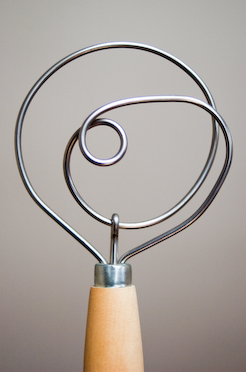
…Might as well surprise him. Time to go dig out the spaezlihöbel…