October 14, 2008

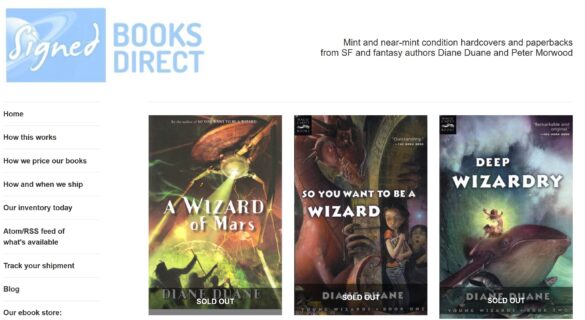
Just got my author’s copy yesterday. The anthology features stories about a suburban U.S. high school catering to young wizards and witches, and my story “The House” bats cleanup in the volume (always a fun position to be in):
She lay face down on her bed, clutching her pillow over the back of her head, and moaned, “It’s useless. Useless!”
In the hallway outside her bedroom, Brianna’s mom had the linen closet open and was stacking sheets in it: Bri could smell the lavender water from here as her mom sprayed it onto layer after layer. And for the moment, the light clean scent infuriated her. Her mother’s compulsive housewifeliness didn’t usually bother Brianna so much except at moments like this, when the world was ending, and how nice the sheets smelled wasn’t even slightly germane.
“Sweetie,” her mom said, “maybe you should just wait a few days and ask him again.”
“It wouldn’t help,” Brianna muttered. “He’d just get the idea I really wanted to do this project with him.”
“Yes, but you do really want to do this project with him.”
“That’s not the point!!”
From out in the hall came the perhaps understandable long silence as her mother tried to parse this statement. Unfortunately Brianna had noticed that her logic and her mom’s sometimes just didn’t intersect, and occasionally serious annotation became necessary. “If I ask him again,” Bri said, pulling the pillow up a little so she wouldn’t have to shout, “he’ll tell everybody that I was desperate. It’ll be all over school. My rep will never recover.”
“Which rep are we talking about, honey?” her mother said, pausing to spray some more lavender water, and then to sneeze. Her mom was allergic to lavender, which always added a slightly surreal quality to this operation in Brianna’s eyes.
“My reputation as an independent kid who doesn’t need anybody’s help to get the job done!”
“Well, you don’t, if you ask me. So do it without him. If he’s not smart enough to want to pair up with you on this science fair thing — ”
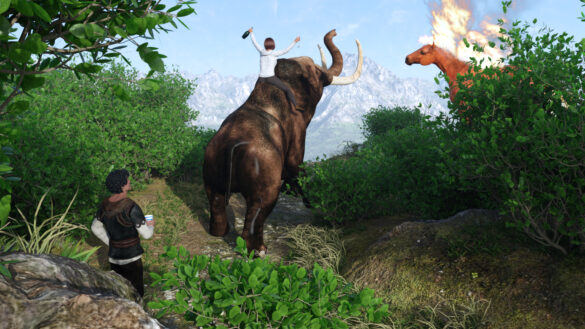
“Parascience, please, Mom! This is not just people fussing around with anemometers and toy erupting volcanoes: it’s going to be the main event of Heritage Week!” Though she had seen Carol Anne Naylor’s plan for a real miniature exploding volcano, genuine magma and all, and had been consumed by envy at not having thought of it first. If it worked, it would be terrific, and even if it malfunctioned, that could still potentially be desperately cool. After all, there was never any guarantee when you were working with a fire elemental, even a baby one, that it wouldn’t get out of hand —
Another few sneezes came from outside, and then the sound of her mother shutting the linen cupboard. A few seconds later her mom came in and sat down on the bed beside Brianna, smelling strongly of lavender. “All right,” she said to Brianna, “I’m missing something here. What exactly is it that makes Arthur Etchison so necessary to what you’ve got in mind?”
His eyes. His shoulder muscles. His haircut. His – But there was no point in getting into this line of reasoning with her mother. Brianna pulled the pillow up over her head again, this time with reason, as she was blushing again. It was the curse of her life: she had always been an easy blusher, and this year when Arthur arrived at school from England, an exchange student, yes, and I’d exchange any ten of our guys for one of him, he is just so – Brianna moaned again, feeling like her face should just about be able to scorch the sheets under it at this point. “Mom, it’s just such a good idea! He’s the King of Shop: he’s got a way with metal, it listens to him. You should see him under the hood — ” Wouldn’t I like to get under his hood!! said one completely unrepentant part of her mind: in response, the blush scaled right up to blowtorch level. She started talking faster, hoping to distract herself. “And nobody, nobody else has even thought about doing anything with the paraphysics of magic swords. Everybody’s all hung up on organics this year, the specific gravity of potions and catalytic thaumachemistry. Or else this vague paperwork stuff, diagramming hexes, the structural analysis of spells.” She waved a hand from under the pillow. “Airy-fairy stuff where nothing’s likely to blow up or make a mess. Nothing concrete. Nothing practical.”
Her mother sat quiet for a moment. “Okay,” her mom said. “So if you can’t ask him again to help you, what are you going to do?”
Brianna was tempted to cover her head with the pillow again… except that wouldn’t help her solve the problem. “Think of some other project?” she said after a moment.
And she does. Then matters ensue which are not merely hilarity.
A lot of good company in this anthology: Kristine Kathryn Rusch, Laura Resnick, Jody Lynn Nye, Esther Friesner, Debra Dixon… Worth a look, I’d say.
Posted in Fantasy and science fiction, Humor, Writing
Comments Off
October 13, 2008
And a lot of boinging. (Courtesy of Nothing To Do With Arbroath.)
Posted in Cats, Humor
No Comments »
October 12, 2008
Can things get any dumber? Don’t answer that question.
“There are millions of people around this world praying to their God – whether it’s Hindu, Buddha, Allah — that [McCain’s] opponent wins for a variety of reasons,” Pastor Arnold Conrad said. “And, Lord, I pray that you would guard your own reputation, because they’re going to think that their god is bigger than you, if that happens.”
(eyeroll) It’s like something out of that old Ken-L-Ration jingle. “My God’s better than your God, my God’s better than yours…” I leave it to others to tease out the five or six hilarious and possibly offensive assumptions and logical fallacies underpinning the above statements. …But the whole thing factors down to: Please, God, don’t embarrass us. Is it just me, or is there something extremely wrong with that entire line of reasoning…and this guy — a clergyman — doesn’t even see it?
Also: has it genuinely never occurred to this cleric that somewhere in America there might possibly be someone praying to the very same God he’s (theoretically) praying to that the Unnamed Opponent should win? And that (to take a slightly different tack) if it turns out to happen that way, that this would — in his theology — be because of his very own God’s will, not as the result of some sublime hyperdimensional WWF match? …No, probably if that concept crept into the guy’s head, said head would explode. Was he perhaps trying to be funny? If so, FAIL.

…And here again we have this weirdness about not naming the other guy even at a distance, let alone when he’s standing six feet away. (“That one?” Tsk tsk.) I mean, surely there’s no point in not-naming even the Lone Power (click here for his version of the icon to the right) or Voldemort when they’re already sitting there waiting for you to finish speaking. Strikes me as rude.
I really, really wish I could just stop reading the news until sometime in December. (mutter) I also really wish I could email stuff like this to C.S. Lewis. Imagine the response.
Posted in Current events, News, Politics, religion
1 Comment »
October 10, 2008
With the world markets doing what they’re doing at the moment, it’s no wonder that past crashes and bubbles are being discussed a lot on the Intarwebz. The Tulip Bubble in particular has been getting a lot of attention, maybe because it just seems so nuts now that we’re used to seeing financial madness mostly centered around the (mis)handling of various kinds of paper.
But here’s an interesting article that suggests maybe what happened with the tulips in 1636–7 wasn’t so crazy after all:
[…the Dutch] were rationally responding, in finest efficient-market fashion, to overlooked changes in the rules of tulip investing.
As European prices for the dramatic flowers rose in the 1630s, many burgomasters—local mayors—started to invest in the bulbs. But in the fall of 1636, the European tulip market suddenly wilted because of a crisis in Germany. German nobles were big fans of tulips and had taken to planting bulbs. But in October 1636, the Germans lost a battle to the Swedes at Wittstock. Then German peasants began to revolt. The German demand for tulips sagged, and princes began digging up their own bulbs and selling them….
The sudden glut caused prices to fall, and Dutch burgomasters began losing money. They were in a bind. Trade in tulip bulbs was conducted through futures contracts: Buyers agreed to pay a fixed price for tulip bulbs at some point in the future. With prices having fallen in the fall, leveraged burgomasters were tied into paying above-market prices for bulbs to be delivered in the spring.
Rather than take their lumps, these politically connected investors tried to change the market rules—and they succeeded.
At which point the thoughtful reader says, uh oh!!
“The present regulations suck? Oh, okay, we’ll just change the rules / deregulate!” Does this sound at all familiar?… And why am I not surprised to hear Kipling muttering in the background?
Then the Gods of the Market tumbled, and their smooth-tongued wizards withdrew
And the hearts of the meanest were humbled and began to believe it was true
That All is not Gold that Glitters, and Two and Two make Four…
To my great delight, one of the columnists at the International Herald Tribune this week heard him too. He was writing more in the political mode… but whatever. (A couple of other commentators have picked up on “The Gods of the Copybook Headings” as well, excerpting one verse or another.) For those curious about the poem’s title: “copybook headings” were proverbs, quotations or mottoes printed in perfect handwriting at the top of each page of an exercise book / notebook. You were meant to copy them down the page to perfect your own handwriting.
This is the whole from which the excerpts come, from one of the English language’s great masters of meter…and concept.
As I pass through my incarnations in every age and race,
I make my proper prostrations to the Gods of the Market Place.
Peering through reverent fingers I watch them flourish and fall,
And the Gods of the Copybook Headings, I notice, outlast them all.
We were living in trees when they met us. They showed us each in turn
That Water would certainly wet us, as Fire would certainly burn:
But we found them lacking in Uplift, Vision and Breadth of Mind,
So we left them to teach the Gorillas while we followed the March of Mankind.
We moved as the Spirit listed. They never altered their pace,
Being neither cloud nor wind-borne like the Gods of the Market Place;
But they always caught up with our progress, and presently word would come
That a tribe had been wiped off its icefield, or the lights had gone out in Rome.
With the Hopes that our World is built on they were utterly out of touch,
They denied that the Moon was Stilton; they denied she was even Dutch;
They denied that Wishes were Horses; they denied that a Pig had Wings;
So we worshipped the Gods of the Market Who promised these beautiful things.
When the Cambrian measures were forming, They promised perpetual peace.
They swore, if we gave them our weapons, that the wars of the tribes would cease.
But when we disarmed They sold us and delivered us bound to our foe,
And the Gods of the Copybook Headings said: “Stick to the Devil you know.”
On the first Feminian Sandstones we were promised the Fuller Life
(Which started by loving our neighbour and ended by loving his wife)
Till our women had no more children and the men lost reason and faith,
And the Gods of the Copybook Headings said: “The Wages of Sin is Death.”
In the Carboniferous Epoch we were promised abundance for all,
By robbing selected Peter to pay for collective Paul;
But, though we had plenty of money, there was nothing our money could buy,
And the Gods of the Copybook Headings said: “If you don’t work you die.”
Then the Gods of the Market tumbled, and their smooth-tongued wizards withdrew
And the hearts of the meanest were humbled and began to believe it was true
That All is not Gold that Glitters, and Two and Two make Four—
And the Gods of the Copybook Headings limped up to explain it once more.
. . . . . . . . . . . . . . . . . .
As it will be in the future, it was at the birth of Man—
There are only four things certain since Social Progress began:—
That the Dog returns to his Vomit and the Sow returns to her Mire,
And the burnt Fool’s bandaged finger goes wabbling back to the Fire;
And that after this is accomplished, and the brave new world begins
When all men are paid for existing and no man must pay for his sins,
As surely as Water will wet us, as surely as Fire will bum,
The Gods of the Copybook Headings with terror and slaughter return!
…A footnote to this in passing: Kipling himself was no stranger to market-based financial trouble, bad investments and bank crashes. Chapter V of his autobiography Something of Myself tells how, on his honeymoon, halfway around the world in Japan, he suddenly discovered that his own bank had crashed, and that at the height of his (early) success he was regardless now completely broke:
Here an earthquake (prophetic as it turned out) overtook us one hot break of dawn, and we fled out into the garden, where a tall cryptomeria waggled its insane head back and forth with an ‘I told you so’ expression; though not a breath was stirring. A little later I went to the Yokohama branch of my Bank on a wet forenoon to draw some of my solid wealth. Said the Manager to me: ‘Why not take more? It will be just as easy.’ I answered that I did not care to have too much cash at one time in my careless keeping, but that when I had looked over my accounts I might come again in the afternoon. I did so; but in that little space my Bank, the notice on its shut door explained, had suspended payment. (Yes, I should have done better to have invested my ‘capital’ as its London Manager had hinted.)
I returned with my news to my bride of three months and a child to be born. Except for what I had drawn that morning–the Manager had sailed as near to the wind as loyalty permitted–and the unexpended Cook vouchers, and our personal possessions in our trunks, we had nothing whatever. There was an instant Committee of Ways and Means [convened], which advanced our understanding of each other more than a cycle of solvent matrimony. Retreat–flight, if you like–was indicated. What would Cook return for the tickets, not including the price of lost dreams? ‘Every pound you’ve paid, of course,’ said Cook of Yokohama. ‘These things are all luck and–here’s your refund.’
Whew…
Posted in Current events, Europe, Finance, Politics
No Comments »
October 8, 2008
Fortunately for me, when I’m plastered I routinely lose the ability to type — at least without committing so many typos that I simply give up on the project until the blood alcohol drops. So this isn’t for me.
But for those who have better motor skills even when inebriated, Google now introduces an app that (when enabled) slows you down with math before you send that late-night boozy message.
Fascinating…
Posted in Uncategorized
No Comments »
October 5, 2008
This morning’s best read… and about time somebody said it. Brava.
Posted in Uncategorized
2 Comments »
October 5, 2008
Apropos of absolutely nothing (except that I want to know where I put this in a couple of weeks, and my bookmark files are beyond congested at the moment):
A comparison of US instant mashed potatoes at Bad Ingredients. (Don’t even ask about Irish instant mashed potatoes. There is only an imported UK brand called Smash ((originally made by Cadburys, and now owned by Knorr, I believe)) that turns out a result exactly mirroring the texture of wallpaper paste. Here in the land of Real Potatoes, Smash is mostly famous for its silly ‘70’s commercials featuring Martians mocking the food habits of those primitive Earthlings; apparently British viewers once voted these the best TV commercials of all time.) Disclaimer: I have sometimes brought home the “Potato Buds” brand for use when I can’t be bothered to boil the real thing. But this would be rare, and a box of Potato Buds would normally last me 3–6 months. That last brand they describe, though? Wow. Anybody know anyplace in New York that carries those?
Never mind. Here’s a compendium of the Smash commercials. (The first one doesn’t have the Martians: the rest do.)
Posted in Uncategorized
No Comments »
October 3, 2008
As a US expat I have the delightful opportunity to vote by mail in national and state elections (for expats they use your last state of residence, which for me is California), and I cast my vote last week. There’s a strange satisfaction about being able to walk down to the mailbox in our local village, slide in the envelope, and walk away knowing that this particular civic duty’s been handled. And a peculiar feeling of calm settles over the weeks that follow in the runup to the first Tuesday in November in any given election year: now I can sit back and watch it all unfold, my part having been played to the last move before the really hectic and desperate ballyhoo sets in.
I got up this morning and found a phrase tickling at the back of my brain, an itch I couldn’t scratch. “Be like stalks.” It itched and itched and wouldn’t go away.
Be like stalks?? WTF?, I thought while I made the tea, and fed the cats, and cleaned up the kitchen a little, and turned on the computer, and did other morning things. The phrase kept niggling. Fortunately, the source-memory popped up before I had to sink to the level of Googling for it.
The phrase comes from here. I should have known the source would have been C.S. Lewis, who’s long served as virtual Obi-Wan to my Luke in various matters. (“What, you mean for once you’re not quoting Eddison??” I hear an ironic husband-voice mutter in the next room. To which the only possible response is, “Oh, shut up, sweetie.”)
I don’t know that the sudden irruption of the stalks-memory had anything to do with last week’s debate, or last night’s. But the core of the article, which Lewis wrote for the Guardian in 1961, expresses some sentiments that I’ve been feeling very strongly lately, and does it in language that in our semantically gun-shy times would be difficult (if not impossible) to get away with. A few passages particularly bear quoting: in them the experienced senior devil Screwtape holds forth on the technique of mass damnation for his colleagues and subordinates at the College of Tempters —
Democracy is the word with which you must lead them by the nose. The good work which our philological experts have already done in the corruption of human language makes it unnecessary to warn you that they should never be allowed to give this word a clear and definable meaning. They won’t. It will never occur to them that democracy is properly the name of a political system, even a system of voting, and that this has only the most remote and tenuous connection with what you are trying to sell them. Nor of course must they ever be allowed to raise Aristotle’s question: whether “democratic behaviour” means the behaviour that democracies like or the behaviour that will preserve a democracy. For if they did, it could hardly fail to occur to them that these need not be the same.
You are to use the word purely as an incantation; if you like, purely for its selling power. It is a name they venerate. And of course it is connected with the political ideal that men should be equally treated. You then make a stealthy transition in their minds from this political ideal to a factual belief that all men are equal. Especially the man you are working on. As a result you can use the word democracy to sanction in his thought the most degrading (and also the least enjoyable) of human feelings. You can get him to practise, not only without shame but with a positive glow of self-approval, conduct which, if undefended by the magic word, would be universally derided. The feeling I mean is of course that which prompts a man to say I’m as good as you.
The first and most obvious advantage is that you thus induce him to enthrone at the centre of his life a good, solid, resounding lie. I don’t mean merely that his statement is false in fact, that he is no more equal to everyone he meets in kindness, honesty, and good sense than in height or waist measurement. I mean that he does not believe it himself. No man who says I’m as good as you believes it. He would not say it if he did. The St. Bernard never says it to the toy dog, nor the scholar to the dunce, nor the employable to the bum, nor the pretty woman to the plain. The claim to equality, outside the strictly political field, is made only by those who feel themselves to be in some way inferior. What it expresses is precisely the itching, smarting, writhing awareness of an inferiority which the patient refuses to accept.
And therefore resents. Yes, and therefore resents every kind of superiority in others; denigrates it; wishes its annihilation. Presently he suspects every mere difference of being a claim to superiority. No one must be different from himself in voice, clothes, manners, recreations, choice of food: “Here is someone who speaks English rather more clearly and euphoniously than I — it must be a vile, upstage, la-di-da affectation. Here’s a fellow who says he doesn’t like hot dogs — thinks himself too good for them, no doubt. Here’s a man who hasn’t turned on the jukebox — he’s one of those goddamn highbrows and is doing it to show off. If they were honest-to-God all-right Joes they’d be like me. They’ve no business to be different. It’s undemocratic.”
…There’s more, and it’s worth reading. But it resolves to this, where Screwtape says:
What I want to fix your attention on is the vast, overall movement towards the discrediting, and finally the elimination, of every kind of human excellence – moral, cultural, social, or intellectual. And is it not pretty to notice how “democracy” (in the incantatory sense) is now doing for us the work that was once done by the most ancient Dictatorships, and by the same methods? You remember how one of the Greek Dictators (they called them “tyrants” then) sent an envoy to another Dictator to ask his advice about the principles of government. The second Dictator led the envoy into a field of grain, and there he snicked off with his cane the top of every stalk that rose an inch or so above the general level. The moral was plain. Allow no preeminence among your subjects. Let no man live who is wiser or better or more famous or even handsomer than the mass. Cut them all down to a level: all slaves, all ciphers, all nobodies. All equals.* Thus Tyrants could practise, in a sense, “democracy.” But now “democracy” can do the same work without any tyranny other than her own. No one need now go through the field with a cane. The little stalks will now of themselves bite the tops off the big ones. The big ones are beginning to bite off their own in their desire to Be Like Stalks.
…So there’s that phrase. Screwtape closes this arc of discussion with a broad policy statement:
We, in Hell, would welcome the disappearance of democracy in the strict sense of that word, the political arrangement so called. Like all forms of government, it often works to our advantage, but on the whole less often than other forms. And what we must realize is that “democracy” in the diabolical sense (I’m as good as you, Being Like Folks, Togetherness) is the fittest instrument we could possibly have for extirpating political democracies from the face of the earth.
For “democracy” or the “democratic spirit” (diabolical sense) leads to a nation without great men, a nation mainly of subliterates, full of the cocksureness which flattery breeds on ignorance, and quick to snarl or whimper at the first sign of criticism. And that is what Hell wishes every democratic people to be.
…Whew! I seriously wonder if the Guardian would be willing to publish that article these days. (Then again, they might. But I doubt it would ever turn up in the Times of London, for reasons of its ownership’s political polarity.)
Anyway. That itch is scratched. Now back to work…. (BTW, The Screwtape Letters is being developed as a film at the moment. Boy, would I love to see that screenplay.)
*A strange echo here, for me, to the spot in The Incredibles (it was on here last night) where the former Buddy, now the faux-superhero Syndrome, snarls, “And when everybody’s special… nobody will be.”
Posted in Current events, Home life, Politics
No Comments »
September 26, 2008
Oh dear. Yesterday the Archbishops of Canterbury and York condemned London-based brokers who indulged in short selling as “bank robbers and asset strippers” and accused them of “generating unimaginable wealth … by equally unimaginable levels of fiction”.
But now it turns out that the Church of England has been quite willing to sell short and hedge currencies when doing so suited its purposes.
Tsk, tsk. Looks like the fiction isn’t entirely localized. (Someone will mention “whited sepulchres” fairly soon, I’m sure.) These guys should really find out what their financial managers are doing before issuing these pronouncements.
(A Pythonesque touch here: the FT also reports that the CoE “[has] £5.6bn under management, mostly in a mix of equity, property and vast tracts of land.”)
Posted in Current events, Europe, News, Politics
No Comments »
September 25, 2008
Well, not too far beyond, we hope.
I’ll sure be watching
this on the lunchtime news…
(ETA: Postponed to Sept. 26 due to cloud / bad weather in France.)
Posted in Current events, Europe, News, Science, Technogeekery, Travel
1 Comment »
September 25, 2008
I’m working on it right now and hope to have it up at the weekend. Apologies for the delay: there have been some home / family issues this last month which have disrupted work. (Nothing serious, just disruptive.)
Thanks, all!
Posted in "The Big Meow", Home life, Writing
No Comments »